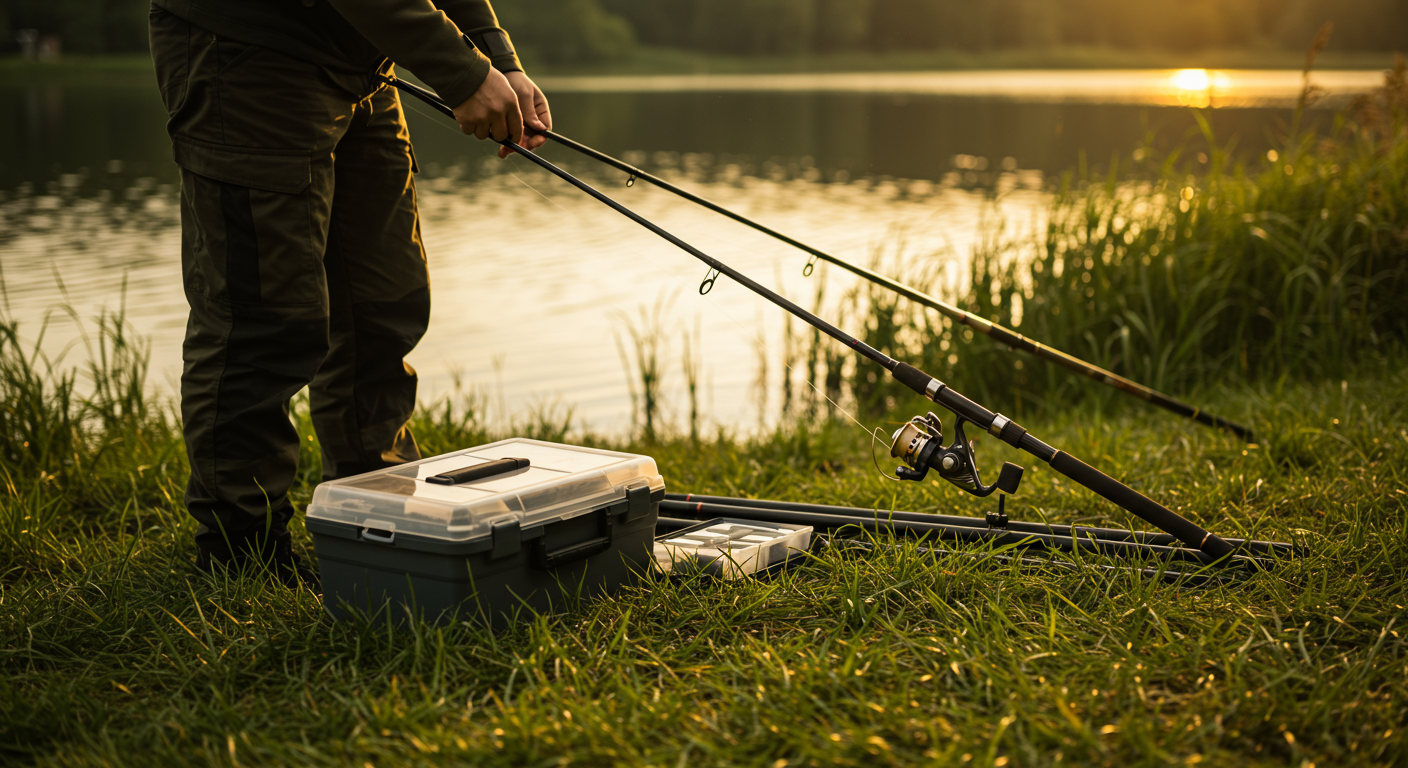
Every expert angler started exactly where you are right now — holding a rod for the first time, not quite sure which end goes in the water. What separates those who fall in love with fishing from those who give up after a frustrating first trip is almost always not talent, but knowledge. This guide gives you everything you need to go from complete beginner to confidently catching fish — covering choosing your first rod and reel, tying the essential fishing knots, and mastering your casting technique — organized in the exact order you need to learn it.
How Fishing Works: The Simple Truth
At its most fundamental level, fishing is about presenting something a fish wants to eat, in a way the fish can find it, in a place the fish is likely to be. That's it. The entire complexity of fishing — the hundreds of lure types, the dozens of techniques, the years of skill development — all serves this simple goal.
Fish spend their lives doing three things: eating, avoiding being eaten, and reproducing. As an angler, you're focused on the eating part. Fish are opportunistic predators and scavengers — they eat what's available, accessible, and worth the energy expenditure. Your job is to present something that looks, smells, or moves like food, in a location the fish can reach with minimal effort.
- Location: Fish don't randomly distribute themselves in the water — they hold in specific spots that offer shelter from current, protection from predators, and proximity to food. Structure (rocks, logs, weed edges, drop-offs) concentrates fish.
- Presentation: How you deliver your bait or lure — depth, speed, action, size — determines whether fish are interested or indifferent.
- Timing: Fish activity follows water temperature, time of day, season, tidal cycles, and barometric pressure. Being on the water during active feeding windows dramatically increases your odds.
Choosing Your First Rod and Reel
The single most common beginner mistake is over-complicating the first gear purchase. You do not need expensive equipment to catch fish. You need appropriate equipment — and for beginners, "appropriate" means simple, forgiving, and versatile.
The Best First Setup: Medium Spinning Combo
A 6.5 to 7-foot medium power spinning rod paired with a size 2500 spinning reel is the ideal first fishing setup. This combination handles the widest range of scenarios — from small panfish to decent-sized bass — with a forgiving action that minimizes casting errors and hook-pulling on light fish. Budget $40–$80 for this setup from brands like Ugly Stik, Shakespeare, or Zebco and you will have everything you need.
| Setup Type | Best For | Advantages | Budget Range |
|---|---|---|---|
| Spinning Combo (7' Medium) | Panfish, bass, trout, walleye | Easy to use, versatile, great for beginners | $40–$120 |
| Closed-Face Spincast Combo | Very young beginners, kids | No open bail to close, virtually no tangles | $20–$60 |
| Cane Pole | Pond panfish, children | Zero mechanical complexity, instant fishing | $5–$30 |
| Fly Rod Combo (9', 5-weight) | Trout streams, fly fishing enthusiasts | Beautiful presentation, requires learning | $80–$200 |
| Surf Casting Combo (10–12') | Beach fishing, piers | Long casts for surf fishing | $60–$150 |
What to Look for in a Beginner Reel
- Smooth drag system that applies consistent pressure without jerking
- Anti-reverse mechanism that prevents the handle from spinning backward when a fish pulls
- At least 3–4 bearings for smooth retrieve (more bearings = smoother)
- Front drag system (more precise adjustment than rear drag)
- Match reel size to rod: size 2500 for light/medium, size 3500–4000 for medium-heavy
Simple Fishing Rigs for Beginners
A fishing rig is the arrangement of components at the end of your line — hook, weight, bobber, and leader — that presents your bait to the fish. You don't need to know every rig in existence to catch fish. You need to know three basic rigs well.
Rig #1: The Bobber (Float) Rig
The classic beginner rig. Attach a clip-on float (bobber) 18–24 inches above your hook. Add a small split-shot sinker just above the hook to keep the bait at the right depth. Bait the hook with a nightcrawler piece or small live bait. When the bobber disappears under the surface or shoots sideways, set the hook. This rig works brilliantly for panfish, perch, crappie, and shallow-water bass.
Rig #2: The Simple Bottom Rig (Carolina Style)
Thread a 1/2–1 oz egg sinker onto your main line, add a barrel swivel, and tie on an 18-inch leader to your hook. The sinker stays on the bottom while the bait moves naturally in the current or water movement. Excellent for catfish, carp, flounder, and bottom-feeding species anywhere from pond to ocean.
Rig #3: The Basic Lure Rig
Tie a snap swivel to your mainline, then clip your lure to the snap. This allows quick lure changes without re-tying. Cast the lure and retrieve it back through the water at a steady pace with occasional pauses. Spinners, spinnerbaits, and small crankbaits work exceptionally well with this setup for bass, pike, and perch.
Casting Basics: Step-by-Step for Beginners
Casting is a physical skill that requires practice to become second nature. The good news is that the basic spinning-reel overhead cast can be learned in a single practice session and becomes instinctive with repetition.
The Basic Overhead Cast (Spinning Reel)
- Grip the rod: Hold the rod handle with your dominant hand, with the reel foot between your middle and ring fingers. Your index finger should be extended to trap the line against the rod blank.
- Trap the line: Hook your index finger around the main line, holding it against the rod blank. Open the bail with your other hand.
- Back cast: With your elbow bent, bring the rod tip back to the 1–2 o'clock position in a smooth arc. Feel the weight of the lure load (bend) the rod tip behind you.
- Forward cast: Drive the rod tip forward in a smooth acceleration toward your target. The motion should feel like driving a nail with a hammer — smooth and then a crisp stop.
- Release: As the rod tip passes the 10–11 o'clock position on the forward cast, open your finger to release the line. The lure should fly toward your target.
- Close the bail: As soon as the lure hits the water, close the bail by rotating the handle (or manually with your hand). You're now ready to retrieve.
Essential Fishing Knots Explained
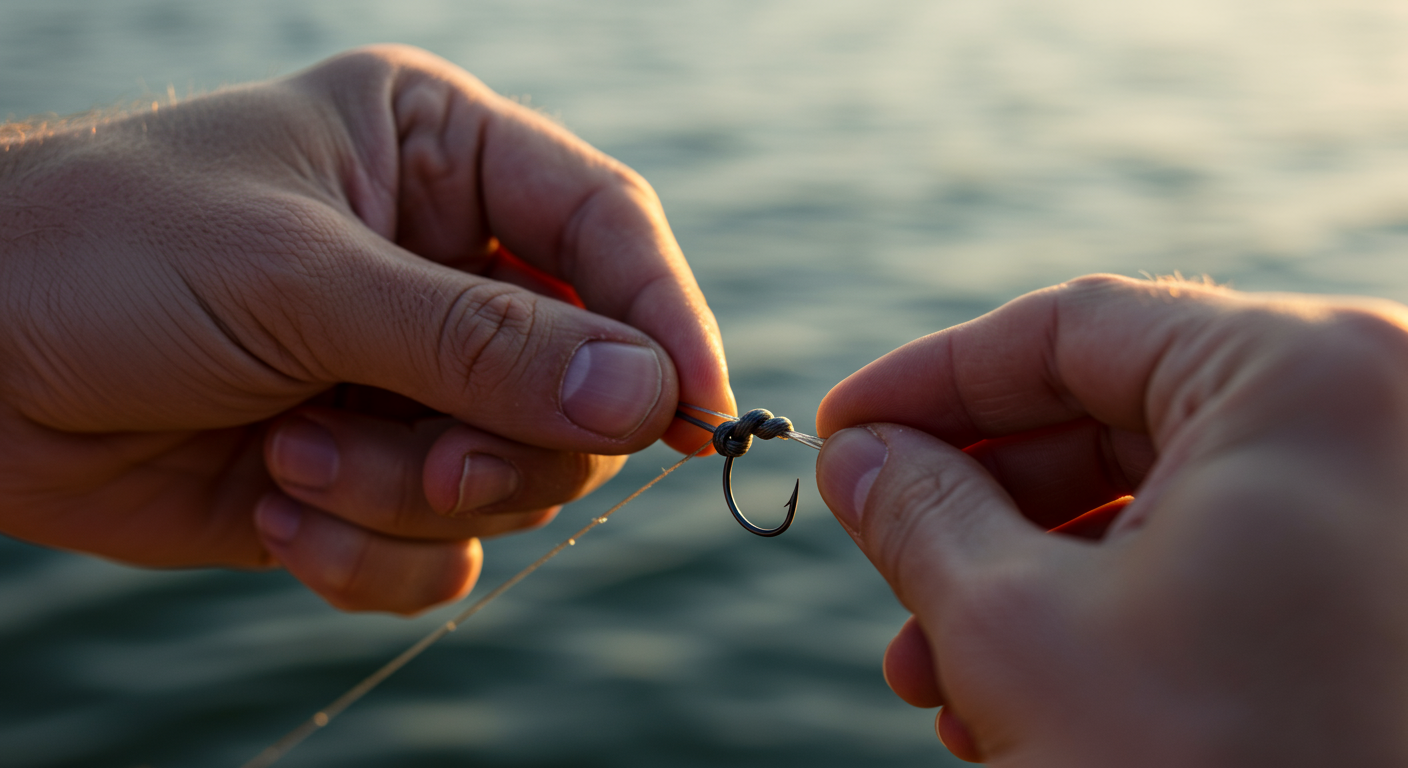
A fishing knot's job is to maintain your line's full rated strength at the connection point. A poorly tied knot can fail at 30–50% of the line's rated strength — meaning a 10 lb test line with a bad knot might only hold 4–5 lbs of pressure. Learn these three knots and you're covered for 95% of fishing situations.
The Improved Clinch Knot
The most widely used fishing knot in the world. Thread 6 inches of line through the eye of the hook, wrap the tag end around the mainline 5–7 times, pass the tag end through the loop near the eye, then back through the large loop just created. Wet the knot and pull tight. Trim the tag end. Rated for nearly full line strength when tied correctly.
The Palomar Knot
Even stronger than the improved clinch on braided line. Double 6 inches of line and pass the loop through the hook eye. Tie a simple overhand knot with the doubled line. Pass the hook through the loop. Wet and pull tight, then trim. Consistently tests at or near 100% of line strength.
The Loop Knot
Creates a loop at the lure attachment point that allows lures to swing freely and express their full designed action. Especially valuable for topwater lures and jerkbaits. Tie an overhand knot 4 inches from the end of the line, pass the tag through the lure eye, and then back through the overhand knot. Wrap 3 times around the mainline and back through. Pull tight to close the loop at the lure eye.
Bait vs Lure: What Should Beginners Use?
| Factor | Live/Natural Bait | Artificial Lures |
|---|---|---|
| Effectiveness | Excellent — especially for beginners | Good — requires more angler skill |
| Learning Curve | Very low — fish do the work | Moderate — must understand retrieve techniques |
| Cost | Low — worms are cheap or free | Higher — quality lures cost $5–$20 each |
| Species Coverage | Excellent — works on most species | Species and technique specific |
| Convenience | Requires fresh bait, proper storage | Store indefinitely, always ready |
| Environmental Impact | Introduced bait species can be harmful in some waters | No live organism transport risk |
| Best First Choice | ✓ Yes — nightcrawlers or minnows | Start after bait fishing is comfortable |
Start with natural bait (nightcrawlers or small minnows) and progress to artificial lures once you're comfortable with the mechanics of fishing. The patience required to master lure technique is best developed after you've already caught plenty of fish on bait and understand the basics of where fish hold and how they behave.
Reading Beginner Fishing Spots
The single biggest factor in fishing success is being in the right place. Beginners often make random casts into open water with no structure — this is the least productive approach. Even the simplest observation skills will dramatically improve your catch rate from your very first outing.
- Look for structure: Any dock, fallen tree, overhanging bush, rock pile, or bridge piling creates shade and shelter that concentrates fish.
- Find the edges: Fish like to be at the edge of things — the edge of a weed bed, the edge where deep water meets shallow water, the edge of shade versus sunlight.
- Watch the water surface: Ripples, swirls, and surface disturbances often indicate feeding fish directly below. Cast to these areas immediately.
- Tributaries and inflows: Where a small stream or drainage enters a pond or lake creates a food funnel — current brings insects and small fish, which attracts larger predators.
- Shady banks: In summer, the shaded north-facing bank of a pond is significantly cooler and holds more fish than the sun-blasted south bank.
First Fishing Trip Checklist
- ☐ Fishing license (purchased in advance online or at a sporting goods store)
- ☐ Rod and reel (pre-rigged at home with bobber, split shot, and hook)
- ☐ Nightcrawlers or other bait (purchased fresh from a bait shop the morning of the trip)
- ☐ Small needle-nose pliers for hook removal
- ☐ Small net for landing fish
- ☐ Bucket with lid if keeping fish for the table
- ☐ Polarized sunglasses
- ☐ Sunscreen and hat
- ☐ Insect repellent (depending on location)
- ☐ Drinking water and snacks
- ☐ Phone for photos and fishing apps
- ☐ Small first aid kit
- ☐ Rain jacket (weather changes quickly near water)
Catch and Release Basics
Catch and release fishing — catching fish and returning them to the water unharmed — is both an ethical practice and increasingly a legal requirement in many fisheries. Done correctly, released fish have very high survival rates. Done poorly, even small fish may not survive.
- Wet your hands before handling fish — dry hands remove the slime coat that protects fish from infection
- Minimize air exposure — most fish should spend less than 30 seconds out of water
- Support the body — don't hold fish vertically by the jaw only; support the body weight with your other hand
- Remove hooks quickly — use needle-nose pliers or a hook remover; if a hook is deeply swallowed, cut the line close to the hook rather than digging it out
- Revive before releasing — hold the fish gently in the water, moving it forward and backward to push water through its gills until it swims away on its own
Beginner Mistakes and How to Avoid Them
- Using too heavy a line: Thick, heavy monofilament is visible to fish in clear water. Start with 8–10 lb monofilament for most freshwater fishing.
- Leaving the drag too tight: A tight drag breaks line when a fish makes a sudden run. The drag should slip before the line reaches its breaking strength.
- Setting the hook too aggressively: A violent hook set with light line snaps the line. A firm, upward sweep of the wrist is sufficient for most fishing scenarios.
- Making noise near the water: Sound travels far underwater. Stomping on a dock, dropping gear, and loud conversation all spook nearby fish.
- Fishing in one spot for too long: If you haven't caught anything in 20–30 minutes, move. Active anglers who cover water consistently outperform stationary ones.
- Neglecting to check the hook tip: A dull or bent hook point reduces your hook-up ratio dramatically. Touch the hook tip to your fingernail — if it catches, it's sharp; if it slides, replace it.
How to Improve Fast as a Beginner Angler
- Fish consistently: Nothing accelerates fishing development like time on the water. Aim for at least one fishing outing per week during your first season.
- Keep a fishing journal: Record the date, time, weather, water temperature, technique, bait, location description, and fish caught. Patterns emerge quickly that would otherwise take years to recognize.
- Talk to experienced anglers: Local fishing forums, bait shop staff, and fishing clubs are invaluable sources of specific local knowledge.
- Watch fishing videos: Watching experienced anglers on video shows you technique details that written descriptions miss — retrieve speed, rod angle, hook-setting mechanics.
- Fish with a mentor: A single half-day with an experienced friend or guide is worth months of solo practice.
- Learn one technique completely: Mastering one technique before adding another builds a deep, reliable foundation rather than shallow competency across many methods.
- ✓ Start simple: a spinning combo with nightcrawlers and a bobber catches fish everywhere
- ✓ Learn to find structure before you learn any technique
- ✓ Master three basic knots and retie frequently
- ✓ Observe the water for 5 minutes before making your first cast
- ✓ Keep a fishing journal from your very first trip
- ✓ Fish consistently — time on the water beats any gear purchase
- ✓ Practice catch and release to protect the fishery for future generations
Frequently Asked Questions
Related Articles & Guides
Fishing Techniques for Beginners: Start Here
TutorialsKey Fishing Knots Every Angler Must Know
TutorialsChoosing the Right Rod for Any Situation
TechniquesCasting Techniques: Master Every Type of Cast
DestinationsBest Beginner Fishing Spots in America
GearFishing Line Selection: Mono, Fluoro, and Braid
TutorialsLure Effectiveness: Which Lures Catch the Most Fish
TutorialsFreshwater Fly Fishing for Beginners
GearBudget Fishing Gear for Beginners
GuideComplete Fishing Techniques Guide
GuideComplete Fishing Gear Guide